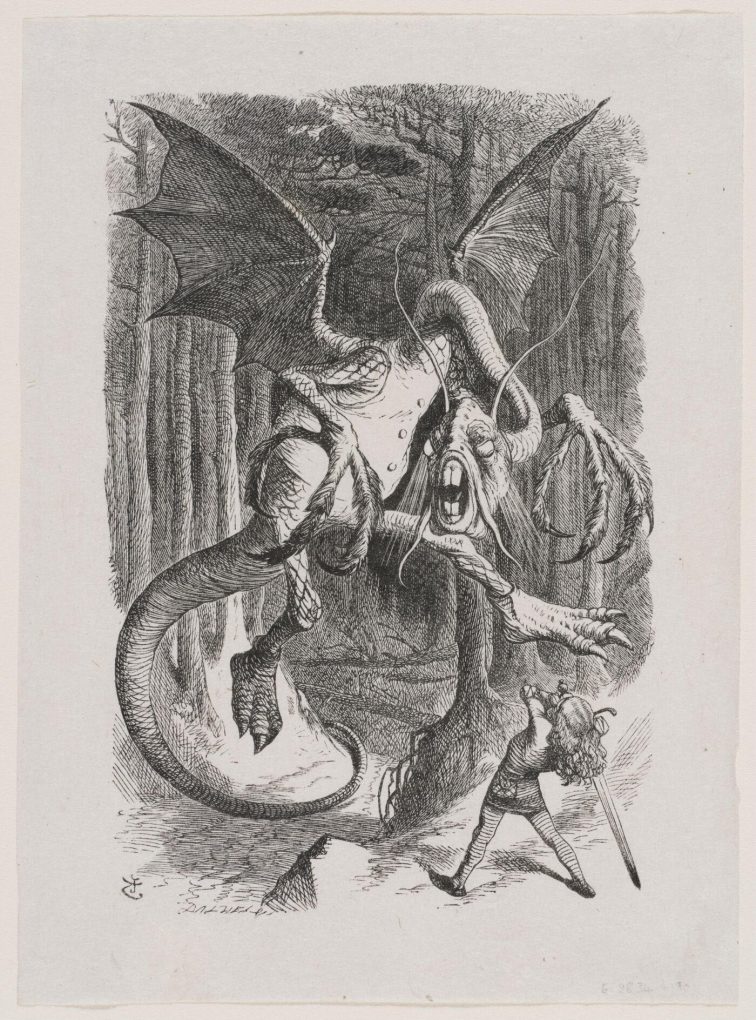
A last-minute addition to Scull and Hammond’s Collected Poems of J.R.R. Tolkien was Tolkien’s translation of Lewis Carroll’s nonsense poem, “Jabberwocky,” which you can find in Appendix V (pages 1403-1410). This poem demonstrates Tolkien’s translation skills that draw on his deep knowledge of Old English grammar, vocabulary, and poetic metre. He not only translates from Modern English into Old English, but he also translates into Old English alliterative metre. And if that isn’t enough, he creates nonsense words in Old English to approximate Carroll’s inventions.
Scull and Hammond include in this appendix the information needed for a closer comparison: we have Tolkien’s Old English version, Carroll’s original poem, and then a close translation of Tolkien’s version into Modern English by Arden R. Smith, who also wrote most of the commentary on the translation.
Here are a few examples of Tolkien’s translation strategies, as explained by Smith:
Beware the Jubjub bird, and shun
the frumious Bandersnatch! (Carroll, lines 7-8)
Tolkien imitates Carroll’s repeated sounds in “Jubjub” by inventing the OE word Géo-géowfugol, (géo-géow bird). Tolkien takes an actual OE word, géo (meaning “once, formerly”) and invents a combination, with the soft “g” rendering the pronunciation, as Smith explains, something like “yo-yo.”
For “Bandersnatch” / Hlóþorlæccan Tolkien worked with Old English words meaning “band of robbers” or “bandit” to make the first part of the compound word (hlóþor) and the Old English word meaning “to seize, grasp, snatch” (læccan) for the second part.
And of course to alliterate with hlóþorlæccan you have to find something to represent “frumious,” a combination of “fuming” and “furious” according to Carroll, which Tolkien translates as hrúmheortne meaning “soot-hearted.”
A few more of my favourites:
For Carroll’s “Tumtum tree” Tolkien uses the Old English word for “belly, womb,” with further connotations of “hollow” – wamb – to create a line with repetition and alliteration: “be wambe wambanbéames,” which Smith translates as “in the hollow of the tummy-tree.”
Carroll’s “snicker-snack” is still recognizable as snicre snacran.
The “beamish boy” becomes tree-like, with the Old English word for tree, béam: hyse béamlica.
And finally, “Callooh! Callay!” is rendered in Old English as “hí lá, hú lá!”
There is much more information to be digested in this Appendix, but if you want to trace further the influence of Lewis Carroll on Tolkien’s work, you can refer to Scull and Hammond’s Reader’s Guide, volume 2, pages 208-213 for the entry on “Carroll, Lewis.”
Hí lá, hú lá!
 Anna Smol: A Single Leaf