I was viewing the recordings made for the British Library’s series on Fantasy: Realms of Imagination, when I was struck by John Howe’s description of his process and how similar it is to some examples that we have by Tolkien.
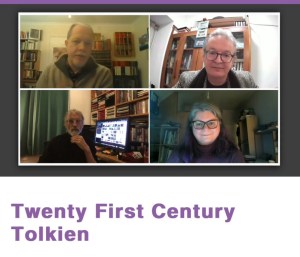
As part of a panel on “Twenty-first Century Tolkien,” Howe explains that he likes to draw his way into a landscape. He describes how he first sketches a landscape from a distance; then imagines himself walking into it by a certain distance and sketching from that perspective; then walking further in and sketching from there, and so on. He says that this approach gives him time to imagine himself walking into the landscape.
You can listen to his description of this process at the link below, starting at 59:40 (although the whole panel discussion is worth listening to as well).
We can see Tolkien doing something similar when he has to imagine characters heading into a new landscape. My colleague Jeff MacLeod and I have written about Tolkien’s process in “Visualizing the Word: Tolkien as Artist and Writer,” published in Tolkien Studies, vol. 14, 2017, p. 115-31. One example that we looked at was Tolkien’s drawing of the Tower of Cirith Ungol (which he spelled “Kirith” at this earlier stage). But before looking at that image, we can see how Tolkien drew his way into this particular landscape.
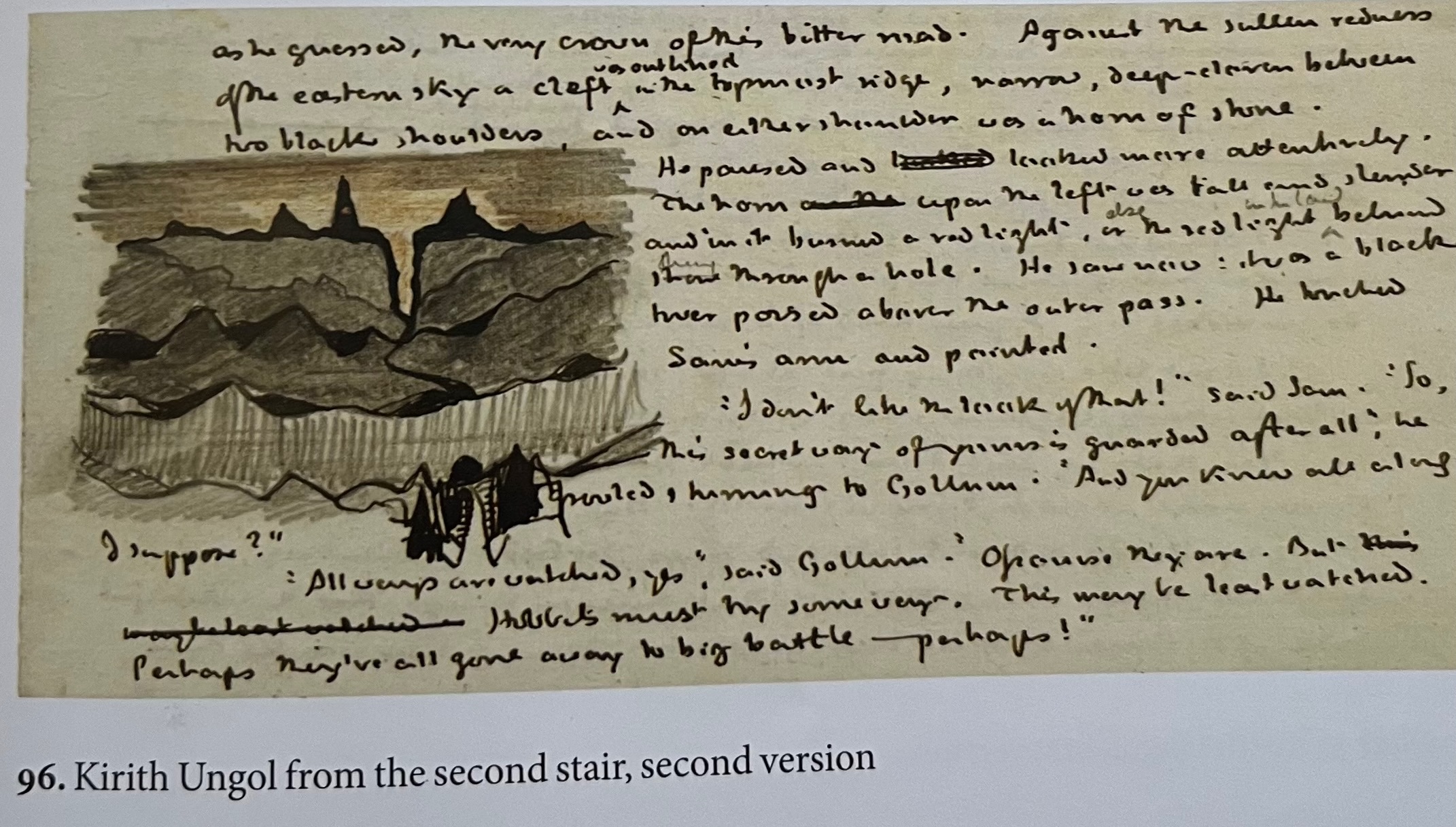
As the hobbits approach the pass of Cirith Ungol, Tolkien makes quick, minimal sketches of the cleft between the mountains. You can see the outline of two mountain peaks on the right side of the image at the end of the third line of Tolkien’s text.

The cleft in the mountains appears again as a simple outline in the text in the image below. Four lines after this minimal outline, however, a much more developed sketch takes over the page, with Tolkien writing around the image, which means that the drawing of the landscape occurred first, and then the story followed. The drawing is leading the way into the story.
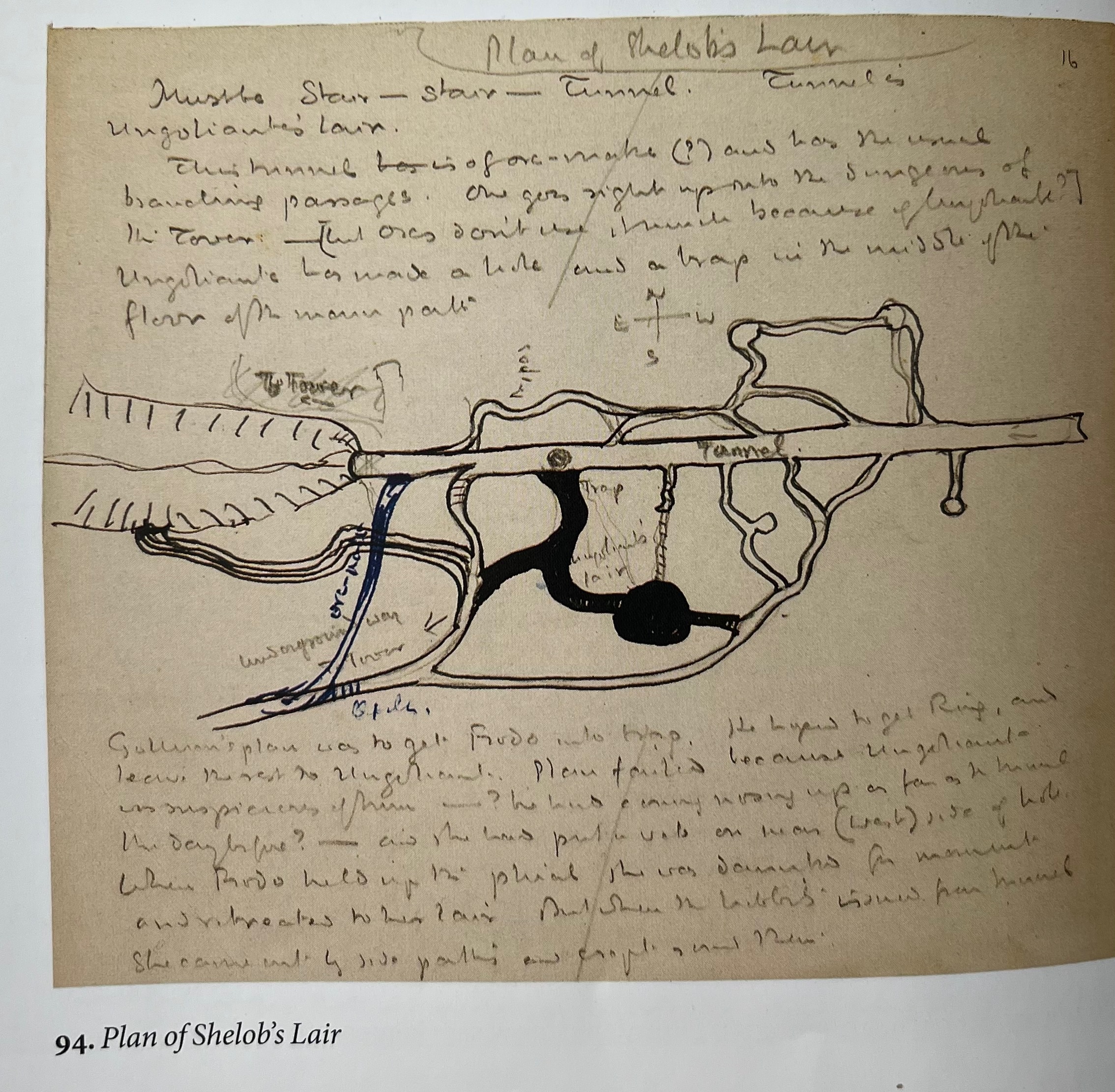
In this larger sketch, the Tower of Cirith Ungol appears only as a dark structure on the other side of the mountains. There is a set of stairs in the bottom left leading into the Lair, and another set of stairs, a bit harder to detect, leading out of the Lair and up.

Once Tolkien gets his hobbits inside the Lair, he can imagine which ways they can go by drawing the Plan of Shelob’s Lair:
A change in the details of the story, in which Tolkien places the second set of stairs before Shelob’s Lair, has him drawing the hobbits’ perspective at this revised point, still with the Tower as a dark structure in the distance:
Tolkien draws the Tower several other times in small sketches, but we can jump ahead to his most detailed drawing. What did Sam see when he actually gets over the pass and closer to the Tower? Tolkien draws the Tower, as seen from the other side of the pass, complete with the winding path that Sam must take, the entrance he must go through, and some rough calculations at the bottom of the page, possibly about the size of the Tower’s tiers.
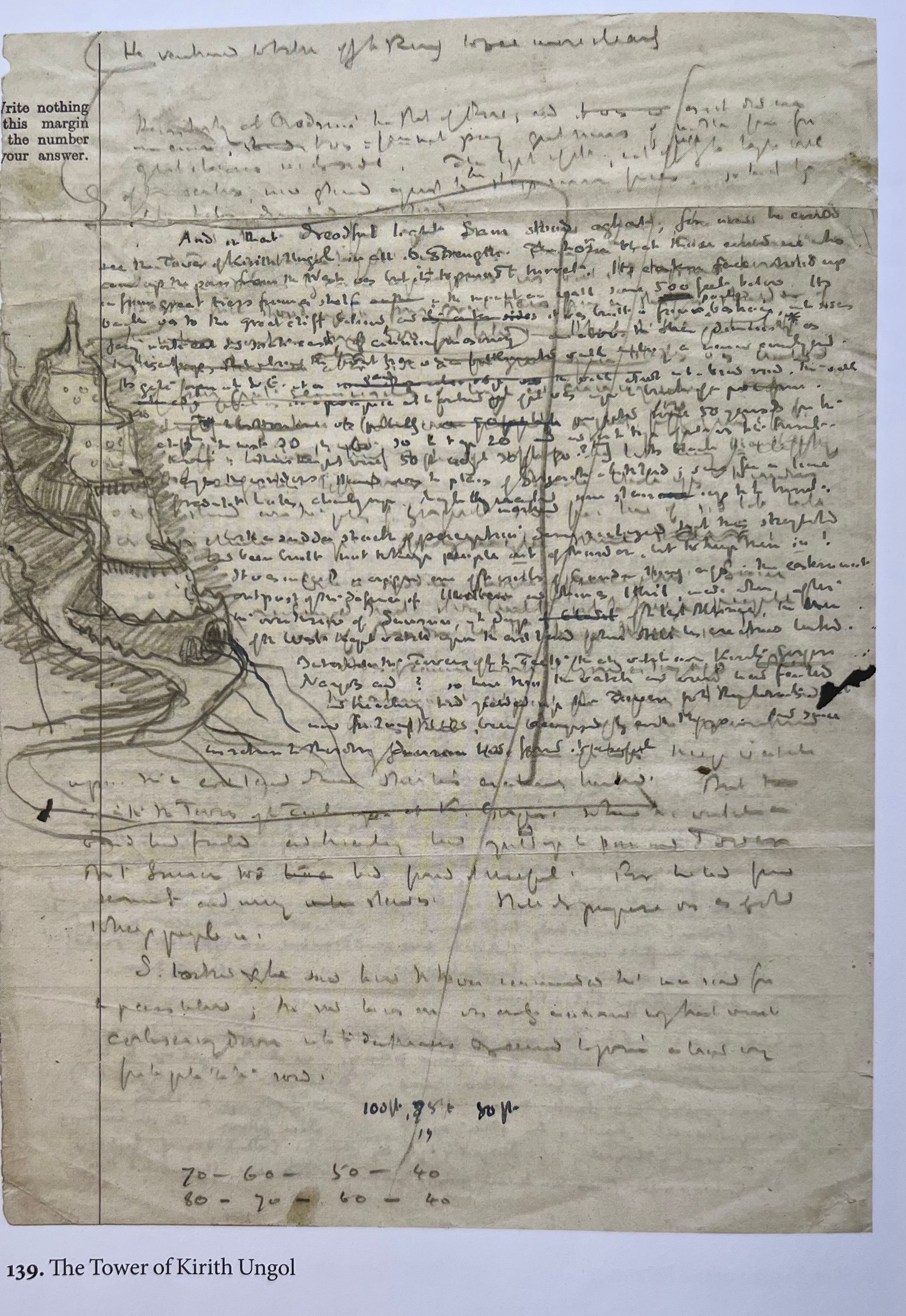
As we explained in our article, the drawing must have preceded the text, starting outside the page margin and then continuing inside the margin, with the writing fitting alongside the irregular edge created by the image. In other words, Tolkien drew the place first in order to imagine what it looked like, and then wrote the description of what was happening as Sam makes his way to this location.
The way to Shelob’s Lair and the Tower of Cirith Ungol are not the only places where we can follow Tolkien’s process of drawing his way into a landscape. Sketches of Minas Tirith or Dunharrow, for example, also illustrate a similar method of entering a landscape through a progression of visual images.
We’re lucky to have Tolkien’s manuscript drafts and the publication of many of his drawings that enable us to see the role of his artwork in the creation of his fantasy landscapes. If you know of other artists / writers who also draw their way into a secondary world, I’d love to read about them in the comments!
Works Cited
Hammond, Wayne G. and Christina Scull, editors. The Art of The Lord of the Rings by J.R.R. Tolkien. HarperCollins, 2015.
MacLeod, Jeffrey J. and Anna Smol. “Visualizing the Word: Tolkien as Artist and Writer.” Tolkien Studies, vol. 14, 2017, p. 115-31.
 Anna Smol: A Single Leaf
One response to “Drawing your way into a fantasy landscape”
[…] Anna Smol ventures into Shelob’s Lair, with the aid of Tolkien’s plans of the […]
LikeLike