Recently, I’ve had two items published dealing with translations and adaptations of Beowulf for young readers, a research area I began working in even before my Tolkien publications.
“Beowulf and Boyology”
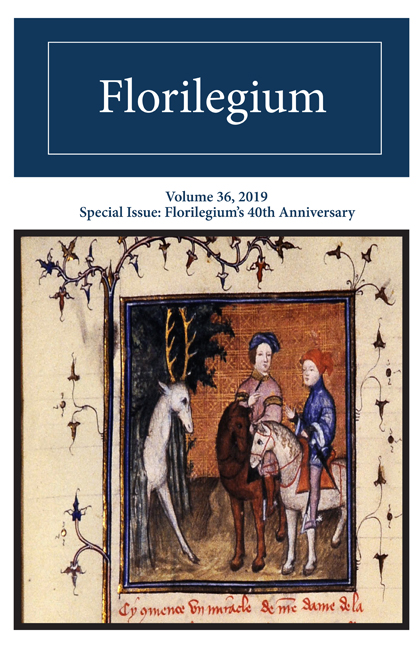
The most recent is my article “Beowulf and Boyology,” just published in Florilegium, the journal of the Canadian Society of Medievalists. To celebrate the 40th anniversary of the journal, the editors have published past CSM Presidents’ addresses. I gave my address in 2012, and that talk is printed in the journal with some minor footnoted updates. The journal issue is dated 2019 (the issues are behind schedule!) but the actual publication just came out yesterday.
Smol, Anna. “Beowulf and Boyology.” Florilegium, vol. 36, 2019, pp. 147-62. DOI: 10.3138/flor-36.008.
Abstract:
Anna Smol’s 2012 talk explores the history of the conflation of ideas about medieval stories and childhood—the way in which texts from the “infancy” or “adolescence” of the English language came to be considered, in the late nineteenth and early twentieth centuries, uniquely suitable for actual children and adolescents. More specifically, these texts were considered appropriate especially for boys and contributed to the development of a field of literature called “boyology.” These texts seemed to uphold values of masculine, martial heroism. In earlier days, those values were combined with nationalist, racist discourses; more recent versions tone those discourses down but maintain the associations of Beowulf with heroic masculinity and primitivism.
Review of Beowulf as Children’s Literature
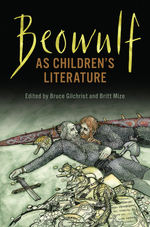
My review appeared in the journal Children’s Literature. I highly recommend this volume of essays, edited by Bruce Gilchrist and Britt Mize, and published by University of Toronto Press (also available on JStor). Here is the opening paragraph of my review, summarizing the value of the book:
“This volume of ten essays, an interview, and an extensive bibliography is an outstanding resource that lays the groundwork for future research in the field of medieval adaptations for young readers. Situated at the intersection of scholarship on children’s literature, Beowulf, medievalism and adaptation studies, this collection covers a long history, from the first Beowulf adaptation for Danish children in 1820 to works by twenty-first-century writers and illustrators, and it suggests various theoretical and critical approaches to the topic of Beowulf adaptations for children.”
For anyone interested in digging further into the topic of medieval literature adapted for children, particularly Beowulf, I’ve published a few other articles in the past (some way back near the beginning of my career!):
- Smol, Anna. “The Child, the Primitive, and the Medieval: Making Medieval Heroes in the Late Nineteenth and Early Twentieth Centuries” in The Hero Recovered: Essays on Medieval Heroism in Honor of George Clark, edited by R.Waugh and J. Weldon, Western Michigan /Medieval Institute Publications, 2010, pp. 208-227.
- Smol, Anna. “The “Savage” and the “Civilized”: Andrew Lang’s Representation of the Child and the Translation of Folklore.” Children’s Literature Association Quarterly, vol. 21 no. 4, 1996, p. 177-183. Project MUSE, https://doi.org/10.1353/chq.0.1288.
- Smol, Anna. “Heroic Ideology and the Children’s Beowulf.” Children’s Literature, vol. 22, 1994, p. 90-100. Project MUSE, https://doi.org/10.1353/chl.0.0664.
As always, if you cannot get access to any of the sources listed in this post, please contact me for a private research copy.

